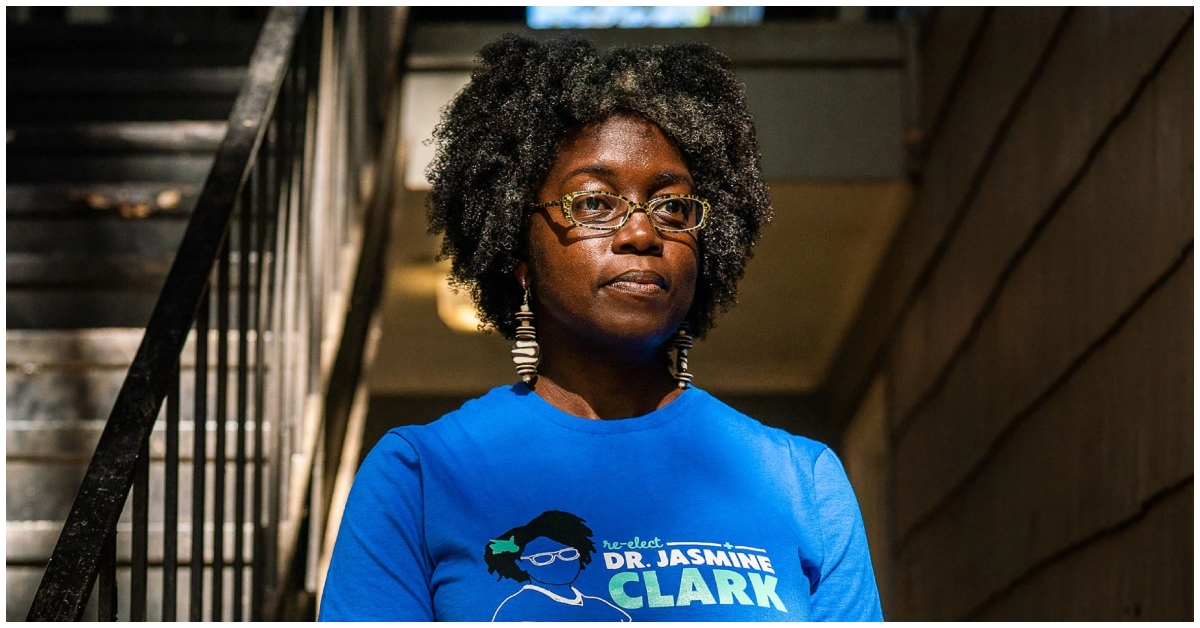
Jasmine Clark is moving closer to a groundbreaking moment in American politics after winning Georgia’s Democratic primary for a U.S. House seat. The microbiologist and state lawmaker is now widely expected to head to Congress in January 2027, where she would become the first Black woman with a science Ph.D. to serve in the U.S. House of Representatives.
Clark secured a strong victory in the primary election, earning 56 percent of the vote against five opponents. Her campaign stood out because she openly centered her scientific background during the race, presenting herself to voters as both a public servant and a scientist prepared to defend facts, research, and public health.
Jasmine Clark’s Georgia Primary Victory Highlights Science in Politics
Unlike many candidates who avoid technical academic credentials during campaigns, Clark leaned heavily into her identity as a scientist. Her campaign ads frequently showed her wearing a lab coat while discussing science, health policy, and truth in government.
Eric Hunter, Clark’s former Ph.D. adviser at Emory University, said the strategy connected strongly with voters.
“The majority of her ads showed her in a lab coat and described her as a scientist,” Hunter explained. “That approach could have backfired, but instead it resonated with voters.”
Clark earned her doctorate in microbiology from Emory in 2013. She later became an instructor at the university’s nursing school, where she taught anatomy and microbiology to students preparing for healthcare careers. Her educational work helped shape her reputation as someone deeply connected to science and public service.
Black Woman Scientist Brings Unique Voice to Congress Race
Clark’s journey into politics began through activism. In 2017, she led the Atlanta chapter of the nationwide March for Science protest movement, which pushed back against attacks on science and public health policies during Donald Trump’s presidency.
That experience inspired her to enter elected office. Just one year later, she defeated a Republican incumbent to win a seat in Georgia’s state legislature. Since then, she has served four terms while building a reputation for supporting science based policies.
“I have a Ph.D. in microbiology, which makes me very different from my colleagues at the statehouse,” Clark said during a radio interview before the primary election. “And I’ve been using my scientific background to fight for policies that make sense for Georgia.”
Her campaign message also focused heavily on protecting public health systems and fighting misinformation. Clark specifically voiced concerns about policies connected to U.S. Health and Human Services Secretary Robert F. Kennedy Jr., saying she wants stronger science leadership in Washington.
Jasmine Clark Builds Momentum Toward Historic U.S. House Seat
Clark’s path to Congress became much clearer after her primary win in the heavily Democratic metro Atlanta district. The seat was previously held by longtime Congressman David Scott, who died in April at age 80 while still serving in office.
Political analysts believe Clark now has a strong advantage heading into the general election. Her Republican opponent, Jonathan Chavez, previously lost badly in the district, while Democratic candidates like Kamala Harris and Raphael Warnock also carried the district comfortably in recent elections.
Supporters say Clark’s scientific training could bring an important perspective to Congress at a time when debates around healthcare, vaccines, public health, and research funding continue to dominate national conversations.
Hunter believes her experience in Georgia politics has prepared her for the challenges ahead.
“Somebody has to be a voice of clarity and authority on science in Congress,” he said. “And she’s quite dynamic.”
Jasmine Clark’s Rise Inspires Black Women in STEM and Public Service
Clark’s success is already inspiring many Black women working in science, healthcare, and education. Her campaign showed that scientific expertise can connect with everyday voters and play a major role in modern political leadership.
Her story also reflects the growing influence of Black women in American politics, especially in spaces where representation has historically been limited. By combining science, education, and community advocacy, Clark has built a political identity that stands apart from traditional congressional campaigns.
As the general election approaches, many supporters see her candidacy as more than a political moment. They view it as proof that expertise, education, and public service can work together to create meaningful change at the national level.