
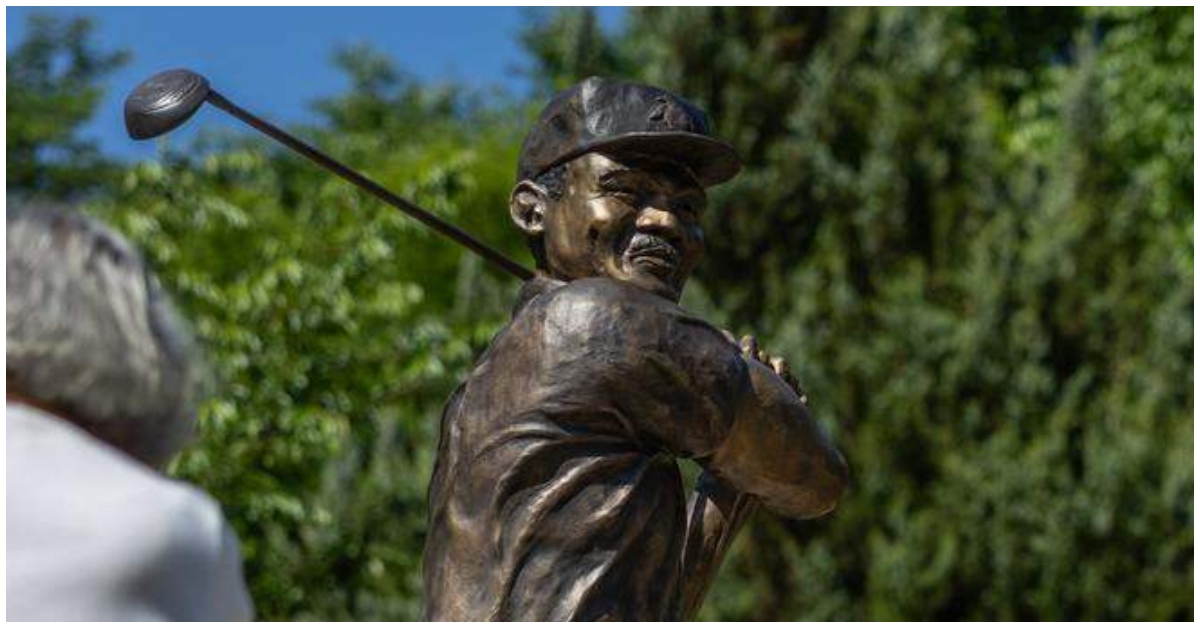
A powerful moment unfolded in Charlotte this week as community leaders, family members, and golf supporters gathered to honor one of the sport’s most influential pioneers. An eight foot bronze statue of Charlie Sifford was officially unveiled at Elizabeth Park, giving the late golf legend a permanent place in the city where his journey first began.
The tribute carries deep meaning. More than six decades ago, Sifford stepped onto the PGA Tour as the first Black golfer to compete at the highest level of professional golf. Now, years after his passing in 2015, his hometown has chosen to celebrate not only his athletic success but also the courage and determination that changed the game forever.
Charlie Sifford Statue Honors a Golf Pioneer in Charlotte
Tuesday’s ceremony brought together local officials, members of the golfing world, and the Sifford family. The statue now stands along Little Sugar Creek Greenway near uptown Charlotte, close to the golf course that already carries Sifford’s name. The unveiling was organized through a partnership between the Truist Championship and the Charlotte Trail of History.
The memorial places Sifford among other important figures who shaped Charlotte’s history. For many attending, it was more than a celebration of golf. It was a reminder of how one person’s determination can leave a lasting impact across generations.
Charles Sifford Jr. spoke emotionally about his father during the event.
“My father never considered himself a trailblazer or a freedom fighter. He just wanted to play the game of golf he fell in love with when he was 10 years old.”
Charlie Sifford’s Journey From Segregation to the PGA Tour
Born in Charlotte in 1922, Sifford’s path to greatness started under difficult conditions. At just 13 years old, he worked as a caddie at the whites only Carolina Country Club, earning only 60 cents a day. Still, he used every opportunity to study the game, often practicing with clubs that had been left behind.
As he grew older, Sifford moved to Philadelphia and started competing professionally in tournaments organized by Black golfers because the PGA Tour still enforced its discriminatory Caucasian only rule. Despite those restrictions, Sifford kept winning and building his reputation.
Eventually, after years of pressure and legal action, that rule was removed. In 1961, at age 39, Sifford entered the PGA Tour as its first Black golfer. His son reflected on the difficult road.
“It was a hard battle. We had many hardships, death threats and other things he had to deal with.”
PGA Tour Success Cemented Charlie Sifford’s Legacy
Sifford did not simply earn a place on the tour. He proved he belonged there. Across his career, he competed in 422 PGA events and won major tournaments including the Greater Hartford Open in 1967 and the LA Open in 1969.
His success continued well into his later years. In 1975, he won the PGA Seniors Championship, one of the biggest events in senior golf at the time. Through it all, Sifford stayed focused on excellence while opening doors for future players.
Golf icon Tiger Woods has often spoken about Sifford’s impact, even calling him “Grandpa Charlie.” Woods once said he might never have reached the PGA Tour without Sifford’s sacrifices and courage.
Charlie Sifford’s Influence Still Inspires Future Generations
Sifford’s impact stretched far beyond trophies. In 2014, he received the Presidential Medal of Freedom from Barack Obama, one of the nation’s highest civilian honors. He was also the first Black member of the World Golf Hall of Fame.
Today, his family continues his mission through scholarship efforts that support young students and student athletes, especially those attending HBCUs. According to his son, the scholarship program has already helped dozens of students pursue higher education.
Standing beside the new statue, Sifford Jr. shared what the moment would have meant to his father.
“He would be humble and proud. I think never in his wildest dreams did he think a day like this would ever come.”
Sifford may no longer be here physically, but his legacy continues to guide the future of golf, leadership, and opportunity for generations to come.


Leave a Reply