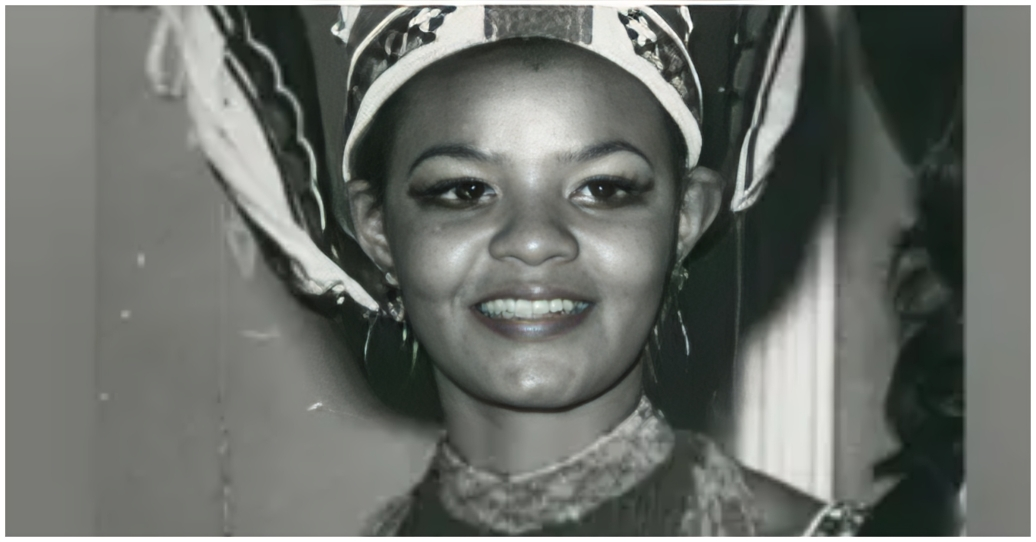
The world is mourning the loss of a true pioneer. Cynthia Shange, the first Black woman from South Africa to break the racial barriers of the global beauty pageant circuit, has passed away at the age of 76. Her death marks the end of an era, but her legacy of courage during the darkest days of apartheid continues to shine brightly across the globe.
According to reports from her family, Shange died on April 20 in a hospital following an illness. Her daughter, Nonhle Thema, announced the sad news on Instagram, sharing a touching photo of her mother. “A graceful and compassionate soul whose presence brought warmth, dignity, and kindness to all those who knew her,” the post read. Thema added that the family is honoring her journey, strength, and the love she shared so generously.
While the world knew her as a beauty queen and actress, to her family she was simply a matriarch. Shange leaves behind four children: Sihle, Nonhle, Ayanda, and Benele Thema. Funeral arrangements are expected to be announced in the coming days as tributes continue to pour in from across the entertainment and political landscape.
From Apartheid’s Shadows to the World Stage: A Historic Victory
In the early 1970s, South Africa was a nation torn apart by apartheid—a brutal system that separated people by race. Black women were explicitly banned from competing in the official Miss South Africa competition. Instead of accepting this injustice, Cynthia Shange chose to defy it by winning Miss Africa South, a pageant created specifically for Black women who were locked out of the mainstream contest.
Her victory was more than a crown; it was a political statement. By simply existing on a stage, Shange proved that Black South African women possessed the same grace, intelligence, and beauty as anyone else. She refused to let the government’s laws define her worth. Shortly after her national win, she took her fight for visibility to the international level.
Shange competed in the Miss World pageant in London in 1972. She traveled alongside the white Miss South Africa contestant, a striking visual of the country’s deep racial divide. Ultimately, Shange finished in fifth place—but the world had already taken notice. She had become South Africa’s first Black beauty queen on a global scale, paving the way for every Black woman who would later wear a sash with pride.
Acting Career and the ‘Lifetime Achiever’ Honor
Beyond the glitter of the pageant world, Cynthia Shange proved she was a multi-talented artist. After her historic run at Miss World, she transitioned smoothly into acting, becoming a familiar face on South African screens. She starred in Udeliwe, which is widely regarded as one of the country’s first Black feature films—a groundbreaking project during a time when Black stories were rarely told on camera.
She later appeared in the award-winning mini-series Shaka Zulu, playing the role of Mkabi KaSodubo. This performance introduced her to an even wider audience, cementing her status as a cultural icon. Even in her later years, the industry never forgot her contributions. In 2024, the KZN Simon Mabhunu Sabela Awards presented her with the Lifetime Achiever Award, recognizing decades of dedication to the arts.
Thamsanqa Ntuli, the Premier of KwaZulu-Natal, released a heartfelt statement honoring the late actress. “Her legacy extends far beyond the stage and screen,” Ntuli wrote. “She played a vital role in advancing the arts as a vehicle for social reflection, healing and nation-building in a democratic South Africa.” He added that the nation has lost not only a cultural icon but a courageous woman who paved the way for many.
Inspiring Generations: A Legacy of Healing and Nation-Building
The impact of Cynthia Shange’s life goes far deeper than the titles she won or the movies she made. For millions of young Black women growing up under apartheid, seeing Shange stand tall on an international stage was a lifeline. She represented hope in a time when the government told them they were inferior. Because she dared to compete, generations of South African women felt empowered to chase their own dreams.
Premier Ntuli captured this sentiment perfectly when he noted that Shange used the arts as a vehicle for healing. After apartheid ended in the early 1990s, South Africa needed figures who could unite a broken nation. Shange’s career—which spanned both the oppressive past and the democratic present—helped bridge that gap. She showed that Black excellence was never absent; it had just been suppressed.
Today, young pageant contestants and actresses across Africa and the diaspora cite Shange as a direct inspiration. She proved that beauty is not just about looks; it is about resilience. Her daughter’s Instagram tribute calls her a soul who brought “warmth, dignity, and kindness” to everyone she met. That is perhaps her greatest crown: not the one from 1972, but the love she earned from her people.
A Final Farewell to a Courageous Soul
As South Africa says goodbye to Cynthia Shange, the mood is one of deep gratitude mixed with sorrow. She passed away in a hospital at the age of 76, leaving behind a trail of broken barriers. The entertainment industry has lost a star, but historians argue that the country has lost a living monument to the fight against racial injustice.
Her journey began on July 27, 1949, when Cynthia Philisiwe Shange was born into a world that would try to limit her. Yet, she refused to be limited. From winning Miss Africa South to standing on the Miss World stage in London, she consistently chose courage over comfort. Later in life, she used her acting platform to tell authentic South African stories, ensuring that the next generation would see themselves represented on film.
The family has asked for privacy as they prepare the funeral arrangements. However, they have made it clear that they want her legacy to continue inspiring action, not just memories. For many, the lesson of Cynthia Shange is simple: you do not have to wait for permission to be great. Even when the law says you cannot compete, you can create your own stage.