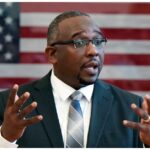
The Evangelical Lutheran Church in America (ELCA) celebrated a powerful milestone on October 4, as Rev. Yehiel Curry was officially installed as its first Black presiding bishop. The ceremony, held at Central Lutheran Church in Minneapolis, marked the beginning of Curry’s six-year term leading the largest Lutheran denomination in the United States — a church that remains over 95% white.
A Historic Installation in Minneapolis
The installation ceremony drew faith leaders, family, and supporters from across the country to witness the moment Curry stepped into his new role. He succeeds the Rev. Elizabeth Eaton, who served for 12 years as the ELCA’s first woman presiding bishop.
“It hasn’t really hit me yet,” Curry said before his installation. “The fact that you’re a first.” His election took place earlier this year on July 30, during the ELCA Churchwide Assembly in Phoenix, and his term officially began on October 1.
For many, his appointment reflects a meaningful shift within a denomination often associated with its Scandinavian and German roots. Rev. Leila Ortiz, a close colleague and former ELCA bishop, said, “He is representing a very white denomination as a Black man from the United States. I think it’s a daunting, daunting call. I trust him, and I trust God.”
From Chicago Roots to National Leadership
Before rising to national leadership, Rev. Curry served as bishop of the ELCA’s Metropolitan Chicago Synod, where the denomination’s headquarters is located. Born on Chicago’s South Side as the seventh of eleven children, he was raised Catholic and worked as a social worker and teacher before discovering the Lutheran tradition.
His faith journey began when he and his wife visited Shekinah Chapel, a young congregation in Chicago known for its dynamic worship and community programs. “For me, it was the traditional Black worship experience except it was a little more contemporary,” he said. “There was poetry, there was liturgical dance, there was a band and praise and worship.”
As Shekinah Chapel grew, so did Curry’s leadership. Through the Theological Education for Emerging Ministries program, he became ordained within the ELCA in 2009 — and later led the same community where his ministry began. “That’s uncommon, where you get to lead in a place where you’ve been raised,” he reflected. “I now recognize how fortunate I am.”
Building Diversity in a Changing Church
Curry’s leadership marks a new chapter for a church body seeking to reflect a more diverse membership. Though the ELCA has made strides toward inclusion — supporting LGBTQ+ clergy and same-sex marriages — racial diversity within leadership remains limited.
Rev. James Thomas, a retired ELCA seminary professor and author of A Rumor of Black Lutherans, noted that Black Lutherans have deep roots in the faith. “Blacks have been around the Lutheran Church since it presented itself in New Amsterdam in the 1600s. We have been present in some small way from the beginning,” he said.
Rev. Yolanda Denson-Byers, an ELCA pastor and author, emphasized how Curry’s visibility highlights this long history. “His leadership helps lift up the fact that African Americans have been contributing to Lutheranism for a very long time, not just here but globally.”
A Vision for Connection and Inclusion
As the fifth presiding bishop since the ELCA’s formation in 1988, Curry will face challenges familiar to other mainline Protestant churches — including theological debates and declining membership. Yet his focus remains on unity, connection, and faith in action.
“There can be a temptation to think that calling a leader of color is enough,” said Bishop Regina Hassanally of the Southeastern Minnesota Synod. “But the reality is that it means creating supports and actually allowing that person to lead out of their full identity.”
Curry echoed this vision, saying he wants to strengthen relationships across every level of the church. “Sometimes you come up with these unique statements and strategies, but then we move on as transition happens,” he said. “I want to take something we’ve affirmed already and maybe dig a little deeper.”
As he begins his term, Curry carries both the weight and hope of history — ready to guide the ELCA toward a more connected and inclusive future rooted in faith and service.